Computers - History
Explore history computer books, including 'A Brief History of Computing.' Discover top computer science, programming, and networking books at our online bookstore with best-selling titles
-
Necessary But Not Sufficient: A Theory of Constraints Business NovelAuthor: Eliyahu M. Goldratt,Eli Shragenheim,Eliyagy M Goldratt Eli SchragenheimPublisher: North River PressPublished: 11/03/2005Pages: 231Binding Type: PaperbackWeight: 0.90lbsSize: 8.90h x 6.00w x 0.70dISBN: 9780884271703
- $39.90 USD
$71.99 USD- $39.90 USD
- Unit price
- per
-
Nexus: A Brief History of Information Networks from the Stone Age to AI#1 NEW YORK TIMES BESTSELLER - From the author of Sapiens comes the groundbreaking story of how information networks have made, and unmade, our world. "Strikingly original . . . A historian whose arguments operate on the scale of millennia has managed to capture...
- $50.00 USD
$89.99 USD- $50.00 USD
- Unit price
- per
-
Nexus: A Brief History of Information Networks from the Stone Age to AIFrom the #1 New York Times bestselling author of Sapiens comes the groundbreaking story of how information networks have made, and unmade, our world. For the last 100,000 years, we Sapiens have accumulated enormous power. But despite all our discoveries, inventions, and conquests, we...
- $58.42 USD
$110.99 USD- $58.42 USD
- Unit price
- per
-
Steve JobsWalter Isaacson's "enthralling" (The New Yorker) worldwide bestselling biography of Apple cofounder Steve Jobs. Based on more than forty interviews with Steve Jobs conducted over two years--as well as interviews with more than 100 family members, friends, adversaries, competitors, and colleagues--Walter Isaacson has written...
- $27.60 USD
$72.99 USD- $27.60 USD
- Unit price
- per
-
Steve JobsWalter Isaacson's "enthralling" (The New Yorker) worldwide bestselling biography of Apple cofounder Steve Jobs. Based on more than forty interviews with Steve Jobs conducted over two years--as well as interviews with more than 100 family members, friends, adversaries, competitors, and colleagues--Walter Isaacson has written...
- $60.00 USD
$103.99 USD- $60.00 USD
- Unit price
- per
-
Steve Jobs for Kids: A Biography of Steve Jobs Just for Kids!He was one of the most brilliant men in the world. Without him, there would be no iPad's, iPhones, or Macbooks. But who was he really? This book, just for kids, will look at his childhood, education, marriage and work to see what made...
- $23.96 USD
$38.99 USD- $23.96 USD
- Unit price
- per
-
The AI Revolution in Medicine: GPT-4 and BeyondAI is about to transform medicine. Here's what you need to know right now. ''The development of AI is as fundamental as the creation of the personal computer. It will change the way people work, learn, and communicate--and transform healthcare. But it must be...
- $47.34 USD
$89.99 USD- $47.34 USD
- Unit price
- per
-
The Computers That Made the WorldThis book tells the story of the birth of the technological world we now live in. It chronicles how computers reshaped World War II. And it does it all through the origins of 12 influential computers built between 1939 and 1950.In 1940, a computer...
- $42.83 USD
$81.99 USD- $42.83 USD
- Unit price
- per
-
The Descent of Artificial Intelligence: A Deep History of an Idea Four Hundred Years in the MakingA 2025 Choice Outstanding Academic Title The idea that a new technology could challenge human intelligence is as old as the warning from Socrates and Plato that written language eroded memory. With the emergence of generative artificial intelligence programs, we find ourselves once again...
- $60.00 USD
$107.99 USD- $60.00 USD
- Unit price
- per
-
The Dream MachineThe story of the man who instigated the work that led to the internet--and shifted our understanding of what computers could be. Behind every great revolution is a vision, and behind perhaps the greatest revolution of our time is the vision of J.C.R. Licklider....
- $30.00 USD
$51.99 USD- $30.00 USD
- Unit price
- per
-
The Fourth Intelligence Revolution: The Future of Espionage and the Battle to Save AmericaA former senior intelligence officer reveals how espionage is being transformed by a new global intelligence race, driven by AI and competition with China, and how this impacts all of our lives. The new global intelligence competition has brought espionage into our workplaces and...
- $48.92 USD
$92.99 USD- $48.92 USD
- Unit price
- per
-
The Inattention Economy: How Women of Color Built the InternetRevealing the unheralded contributions of women of color to the foundation and development of the digital economyThe Inattention Economy challenges the widespread myth that the internet was born from the labor of a handful of white male entrepreneurs, recovering the uncredited and unpaid contributions...
- $29.94 USD
- $29.94 USD
- Unit price
- per
-
The Innovators: How a Group of Hackers, Geniuses, and Geeks Created the Digital RevolutionFollowing his blockbuster biography of Steve Jobs, Walter Isaacson's New York Times bestselling and critically acclaimed The Innovators is a "riveting, propulsive, and at times deeply moving" (The Atlantic) story of the people who created the computer and the internet. What were the talents...
- $37.69 USD
$72.99 USD- $37.69 USD
- Unit price
- per
-
The Irrational Decision: How We Gave Computers the Power to Choose for UsHow the computer revolution shaped our conception of rationality--and why human problems require solutions rooted in human intuition, morality, and judgment In the 1940s, mathematicians set out to design computers that could act as ideal rational agents in the face of uncertainty. The Irrational...
- $47.29 USD
$89.99 USD- $47.29 USD
- Unit price
- per
-
The Last Best Place on the Internet: A Human History of WikipediaOne of the keystone inventions of the twenty-first century, Wikipedia is the largest repository of human knowledge ever made, with editions in 343 languages, read by millions of people every day. Yet, its rightful status as a "digital wonder of the world" is coupled...
- $35.98 USD
- $35.98 USD
- Unit price
- per
-
The Myth of Artificial Intelligence: Why Computers Can't Think the Way We Do"Exposes the vast gap between the actual science underlying AI and the dramatic claims being made for it." --John Horgan "If you want to know about AI, read this book...It shows how a supposedly futuristic reverence for Artificial Intelligence retards progress when it denigrates...
- $39.90 USD
$71.99 USD- $39.90 USD
- Unit price
- per
-
The Rise and Fall of the Artificial State"Much in history is headlong but few grand transformations have been more precipitate or more heedless than the rise of . . . the Artificial State," writes Jill Lepore in this passionate account of how rule by machine has ravaged the world. Inspired by...
- $35.98 USD
- $35.98 USD
- Unit price
- per
-
The Shortest History of AI: The Six Essential Ideas That Animate ItSince Alan Turing first posed the question "Can machines think?" artificial intelligence has evolved from a speculative idea to a transformative force. The Shortest History of AI traces this evolution, from Ada Lovelace's visionary work to IBM's groundbreaking defeat of the chess world champion...
- $29.06 USD
$55.99 USD- $29.06 USD
- Unit price
- per
-
The Soul of a New MachineTracy Kidder's "riveting" (Washington Post) story of one company's efforts to bring a new microcomputer to market won both the Pulitzer Prize and the National Book Award and has become essential reading for understanding the history of the American tech industry. Computers have changed...
- $39.97 USD
$71.99 USD- $39.97 USD
- Unit price
- per
-
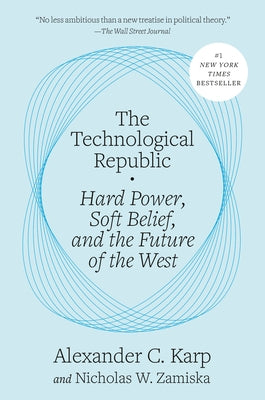
The Technological Republic: Hard Power, Soft Belief, and the Future of the WestINSTANT #1 NEW YORK TIMES BESTSELLER - "A cri de coeur that takes aim at the tech industry for abandoning its history of helping America and its allies."--The Wall Street Journal From the Palantir co-founder, one of Time's 100 Most Influential People of 2025,...
- $47.37 USD
$89.99 USD- $47.37 USD
- Unit price
- per