Computers - Hardware - Chips & Processors
Browse our collection of computer hardware books, including chips & processors and networking titles. Find the best-selling books to enhance your knowledge in technology and computer science.
-
Arduino: 101 Beginners Guide: How to get started with Your Arduino (Tips, Tricks, Projects and More!)Amazon #1 Best Seller in Microcomputers and Technology - Download it Now! Want to learn how to C language from Adruino? Do you want to be an absolute expert in Arduino and dominate your competiton? This book contains proven steps and strategies on how...
- $17.92 USD
$28.99 USD- $17.92 USD
- Unit price
- per
-
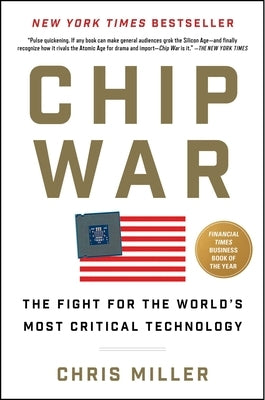
Chip War: The Fight for the World's Most Critical TechnologyThe Financial Times Business Book of the Year, this epic account of the decades-long battle to control one of the world's most critical resources--microchip technology--with the United States and China increasingly in fierce competition is "pulse quickening...a nonfiction thriller" (The New York Times). You...
- $40.00 USD
$74.99 USD- $40.00 USD
- Unit price
- per
-
Chip War: The Fight for the World's Most Critical TechnologyThe Financial Times Business Book of the Year, this epic account of the decades-long battle to control one of the world's most critical resources--microchip technology--with the United States and China increasingly in fierce competition is "pulse quickening...a nonfiction thriller" (The New York Times). You...
- $36.00 USD
$68.99 USD- $36.00 USD
- Unit price
- per
-
Embedded Systems with ARM Cortex-M Microcontrollers in Assembly Language and C: Fourth EditionThe book introduces basic programming of ARM Cortex-M cores in assembly and C at the register level, and the fundamentals of embedded system design. It presents basic concepts such as data representations (integer, fixed-point, floating-point), assembly instructions, stack, and implementing basic controls and functions...
- $115.83 USD
$205.99 USD- $115.83 USD
- Unit price
- per
-
Embedded Systems with ARM Cortex-M Microcontrollers in Assembly Language and C: Third EditionThe book introduces basic programming of ARM Cortex-M cores in assembly and C at the register level, and the fundamentals of embedded system design. It presents basic concepts such as data representations (integer, fixed-point, floating-point), assembly instructions, stack, and implementing basic controls and functions...
- $115.83 USD
$205.99 USD- $115.83 USD
- Unit price
- per
-
The AVR Microcontroller and Embedded Systems Using Assembly and C: Using Arduino Uno and Atmel StudioThe AVR microcontroller from Atmel (now Microchip) is one of the most widely used 8-bit microcontrollers. Arduino Uno is based on AVR microcontroller. It is inexpensive and widely available around the world. This book combines the two. In this book, the authors use a...
- $49.34 USD
$93.99 USD- $49.34 USD
- Unit price
- per
-
The Scaling Era: An Oral History of Ai, 2019-2025An inside view of the AI revolution, from the people and companies making it happen. How did we build large language models? How do they think, if they think? What will the world look like if we have billions of AIs that are as...
- $50.00 USD
$87.99 USD- $50.00 USD
- Unit price
- per